
Europe · Window Manufacturer
Arian Glass (Arian Nicoll): Window Cleaning Guide
🇷🇴 Romania · Last reviewed by Justin Orloff
For owners, installers and cleaners looking after Arian Glass (Arian Nicoll) windows. The maker's own care advice first, then what I add as a window cleaner since 1999.
Quick Facts
- Founded
- Not publicly stated
- Headquarters
- Bucharest, Romania
- Materials
- Aluminium and PVC
- Glazing
- Varies by specification
- Market tier
- Mid-Range
Brand at a Glance
- Brand name
- Arian Glass (Arian Nicoll)
- Country
- Romania
- Headquarters
- Bucharest, Romania
- Product type
- Finished windows and doors
- Frame materials
- Aluminium and uPVC
- Market
- Romanian domestic and regional export
- Standards
- CE marked
- Window types
- Casement, tilt-and-turn, sliding, entrance doors
- Market tier
- Mid-Range
- Distribution
- Direct supply and through local construction supply chains
- Official website
- www.arian-glass.com
Product Range
- Aluminium tilt-and-turn windows
- PVC tilt-and-turn windows
- Aluminium and PVC entrance doors
- Sliding and patio door systems
Why This System
Romanian manufacture combines EU-standard components with lower assembly costs, positioning Arian Glass competitively for regional residential and construction projects. Dual-material production in aluminium and PVC from a single supplier simplifies procurement for mixed-specification projects. Bucharest location gives access to central and eastern European markets where similar price-to-specification ratios drive purchasing decisions. Post-EU-accession Romanian manufacturers have access to the same European component supply chains as west European competitors. Finished product manufacturing (rather than profile supply) gives Arian Glass control over final assembly quality and glazing specification.
Step 1 of 2: Manufacturer Recommendations
Official Care Guidance
Source: ORLOFFS PROFESSIONAL GUIDANCE - BASED ON ARIAN GLASS PUBLISHED INFORMATION AND FIELD EXPERIENCE SINCE 1999
Glass
- Clean with pH-neutral glass cleaner on a microfibre cloth. Squeegee for streak-free finish.
- Inspect glazing gaskets annually - continental climate temperature ranges accelerate gasket hardening.
- Check glazing bead integrity on PVC units each year, particularly at corners where beads are most likely to lift.
- Condensation between panes means IGU seal failure - cleaning cannot fix this. Replacement is required.
- Do not use abrasive materials on glass surfaces.
Frames
- Aluminium frames: pH-neutral detergent and water, soft cloth, rinse and dry immediately.
- PVC frames: pH-neutral detergent and warm water, soft cloth, no abrasives or solvents.
- Apply protective wax to aluminium frames and PVC restorer cream to white uPVC twice yearly.
- Clear drainage holes every 6 months.
- Check perimeter frame sealant at masonry interface each spring.
Hardware
- Lubricate all multipoint hardware, hinges, and pivot points with PTFE spray or light machine oil twice yearly.
- Identify hardware brand from markings for spare parts purposes.
- Check handle fixing screws annually and tighten as needed.
- Test full tilt-and-turn function after every service.
- Report stiff or increasingly heavy handles before hardware damage progresses.
Step 2 of 2: The Orloffs Protocol
The Orloffs Protocol
This is how I clean Arian Glass (Arian Nicoll) windows. The tools and technique below come from daily professional work on the glass since 1999. Every step has been tested on real installations and adapted specifically for Arian Glass (Arian Nicoll) systems.
Follow these steps in order. Each one builds on the last. This is the same sequence I use on every Arian Glass (Arian Nicoll) installation.
Pro Tools
My daily tool list. This is what I carry to every job.
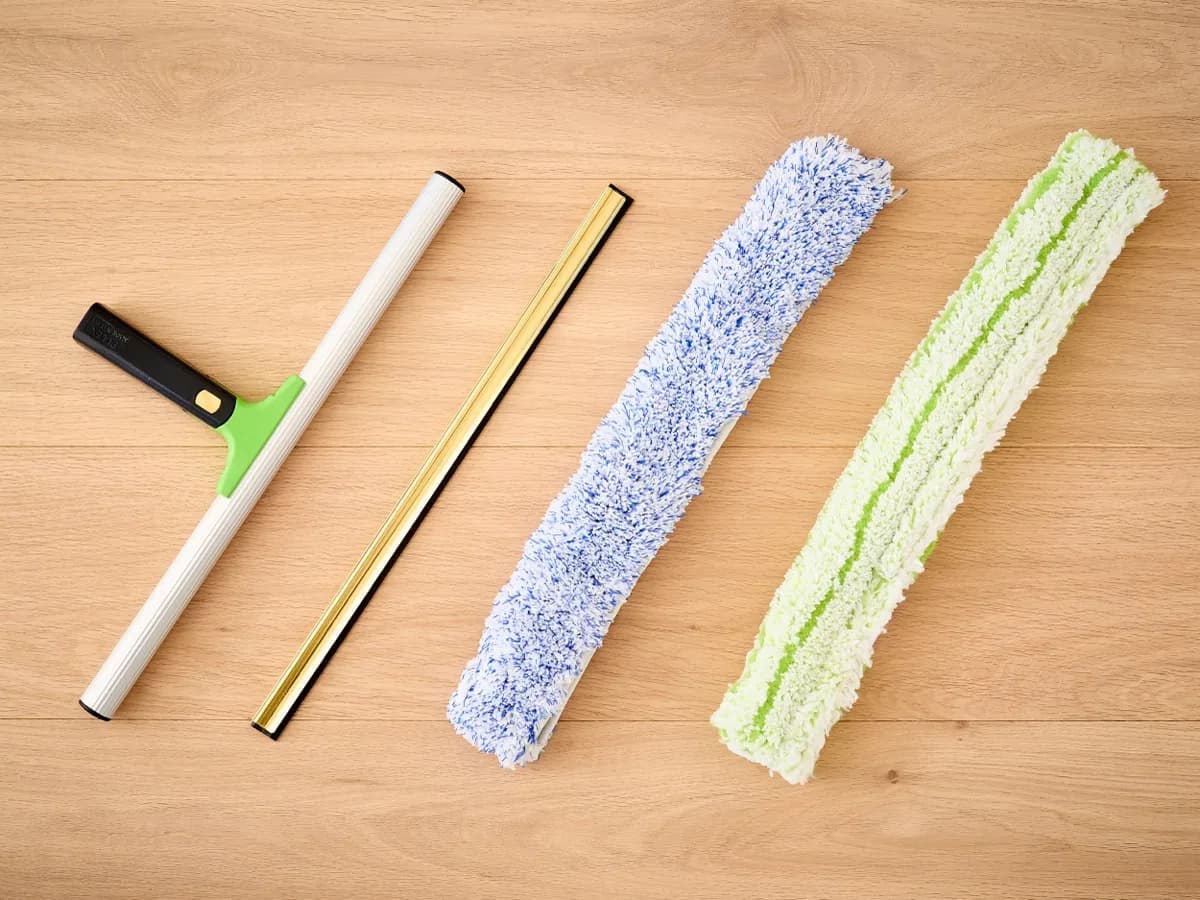
- 1Microfiber T-bar applicator, kept clean and rinsed regularly to prevent grit
- 2Professional squeegee with a fresh rubber blade
- 3Extension pole for glass above arm height
- 4Bucket with at least 10 litres of water and enough soap for cleaning power without excess foam
- 5100% cotton towelling rags for edge detailing
- 6Vacuum for sill tracks and base profiles
Preparation: before any water touches the glass
Fill the bucket with at least 10 litres of water. Add soap for cleaning power: enough to cut through environmental deposits, not so much you are fighting foam.
Before touching the glass, brush down the surface to remove loose dust, spiderwebs, and debris. Any grit left on the glass during the wash phase risks scratching during agitation.
Check the glass frame condition before you start. Confirm which cleaning product is safe for that surface before opening any bottle.
Cover anything below the windows that cannot be moved.
Agitation: apply and work the solution
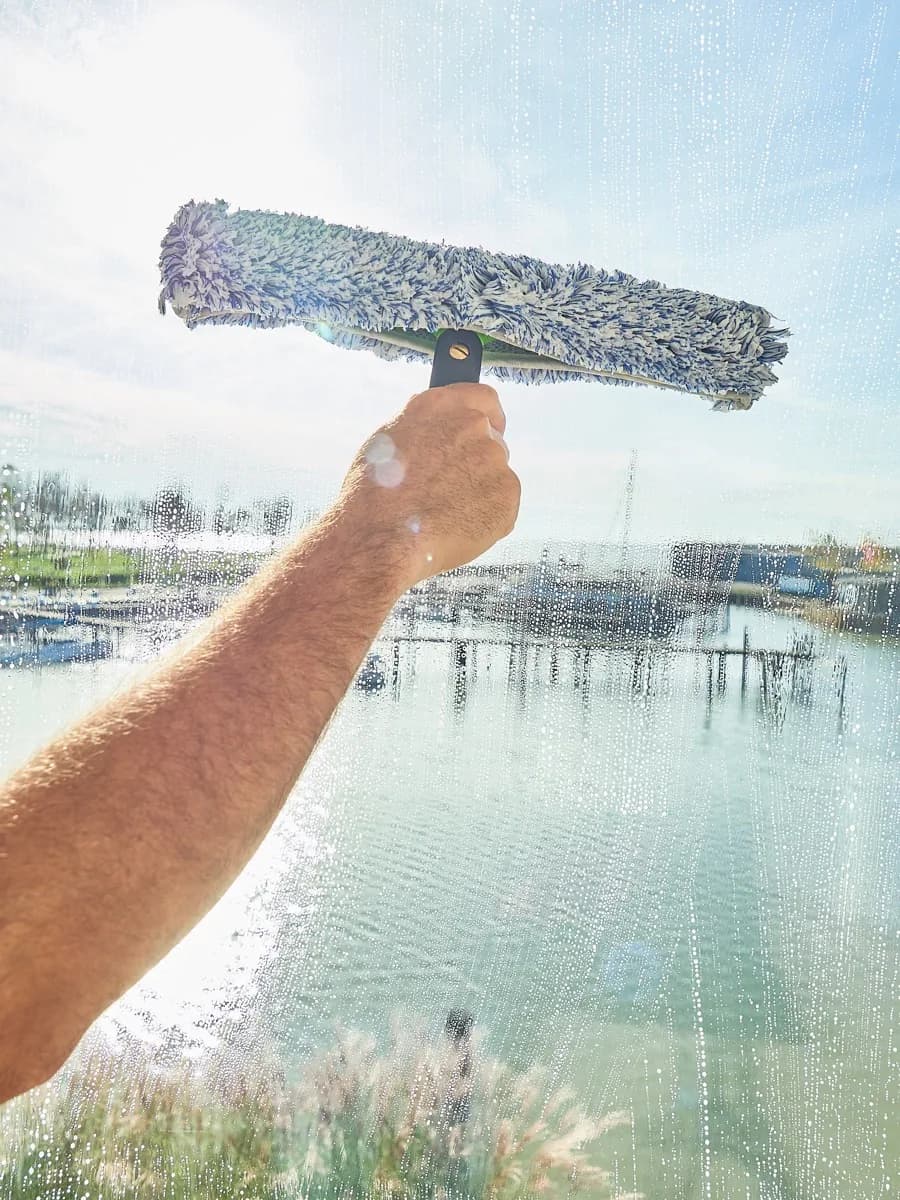
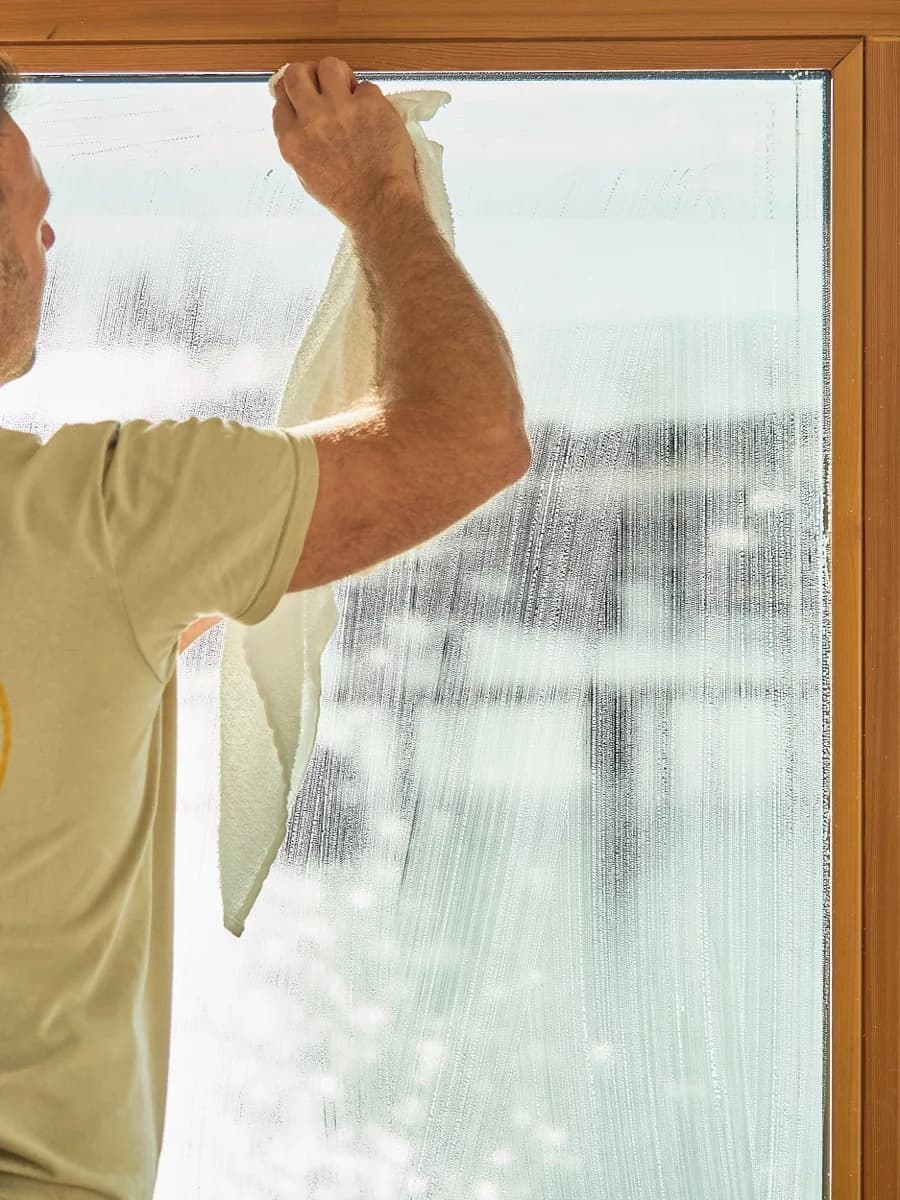
Dip the microfiber T-bar completely into the soap water, both sides. Remove excess water with your hand so it does not drip. Apply the solution across the entire glass surface with overlapping passes.
The goal is to fully dissolve and release every deposit from the glass surface. Anything not released during agitation gets transported across the glass by the squeegee as a smear.
For stubborn spots (insect marks, salt residue, environmental deposits), re-apply soap water and allow it to soak for a full minute before agitating again. Use more soap water, not more pressure.
For panels above arm reach: attach the T-bar to an extension pole. Work in sections (top first, then middle, then bottom), keeping each section wet until you squeegee it.
Rinse the T-bar cover regularly during the job. A dirty applicator causes microscopic scratches that accumulate over time.
Detail the frame edge before squeegeeing
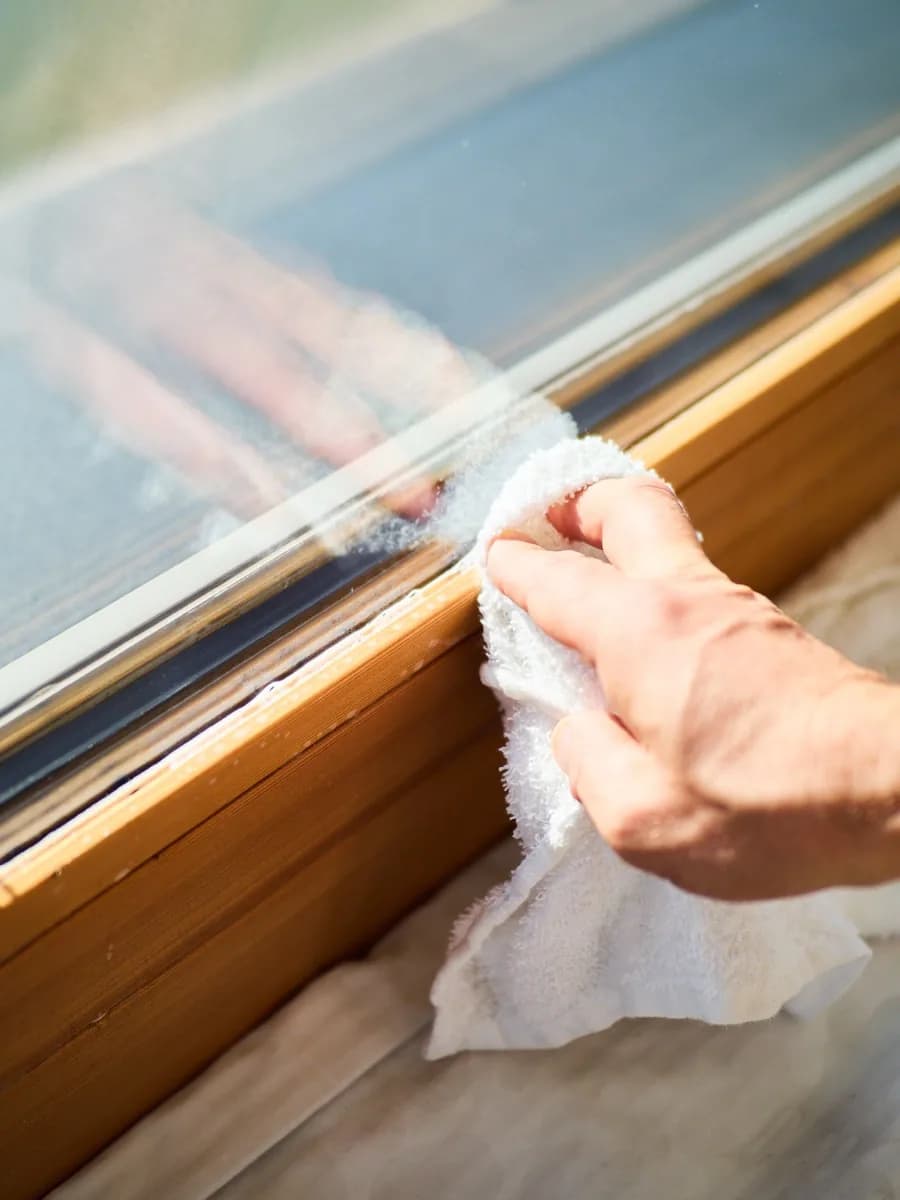
Use your 100% cotton towelling rag, finger pressed into the fabric, to work into every junction and remove pooled soap water before the squeegee pass.
This prevents drips running down onto already-cleaned areas during squeegeeing and keeps soap water out of drainage channels.
On Arian Glass glass frames, pay particular attention to the bottom edge where glass meets the frame sill: water pooled here runs into drainage openings and leaves residue over time.
The squeegee
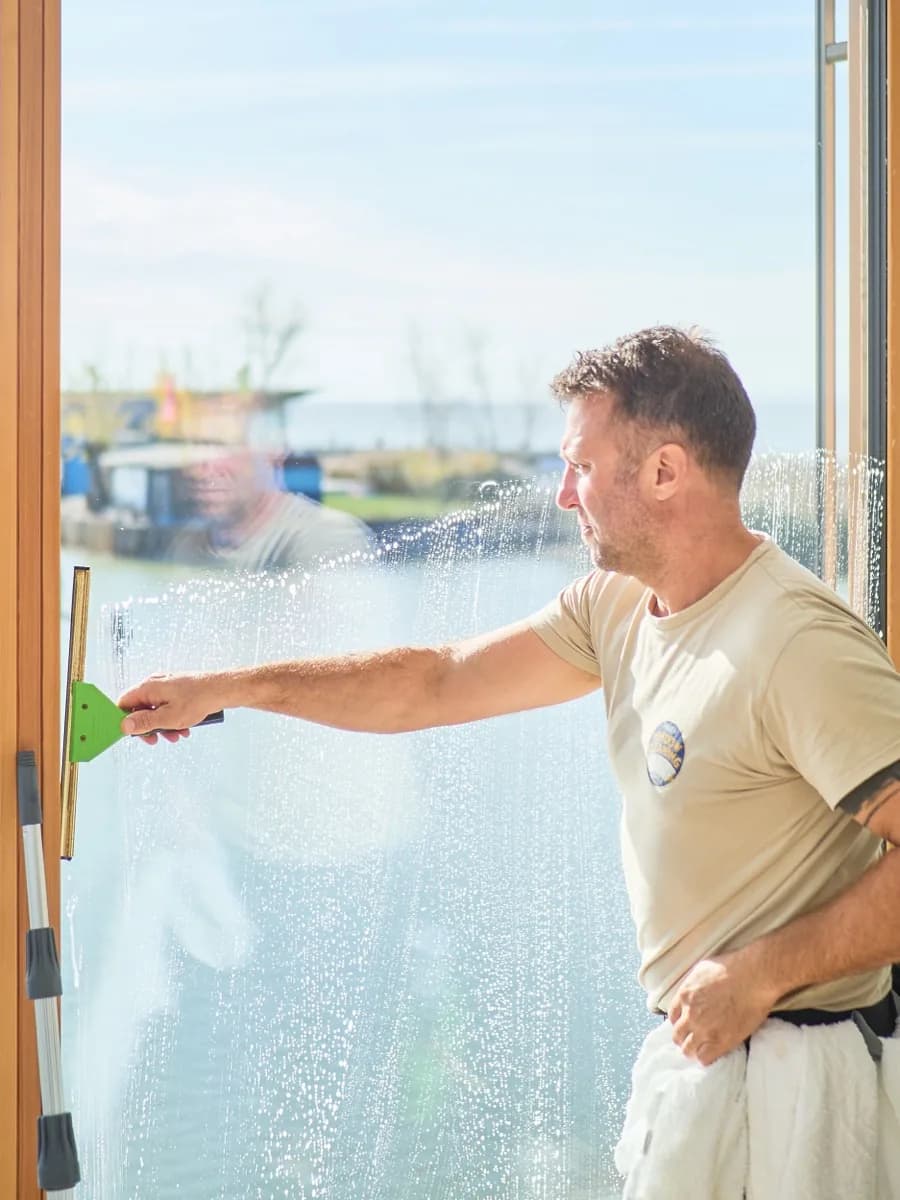
Tilt the squeegee at a slight angle so soap water spills from one side of the channel only, not both. If the rubber is jumping or squeaking, either the rubber is not lubricated enough or the glass surface has warmed.
Cutting in: start with the rubber blade making first contact on a dry edge of the glass.
Side to side: horizontal passes across the panel. Works well on wide sections. Top to bottom: vertical passes down the panel. Works well on tall narrow sections.
The J turn: one smooth unbroken motion top to bottom, wrist rotating at each end to reverse without lifting the rubber. The most efficient method on larger panels, but it requires training before applying it to premium glass.
Wipe the rubber dry after every pass. Overlap each stroke by 2-3 cm.
Final edge detailing
After squeegeeing, there is always a residual line of water along the bottom edge and at the panel sides. Take a dry cotton rag, fold to a clean corner, and detail these edges in one smooth pass.
On Arian Glass frames, the bottom edge where glass meets the sill requires the most careful attention. Water left here runs into drainage and leaves residue that affects the next clean.
Rotate the rag to a clean section after every pass. If the rag picks up grit at any point, replace it immediately.
Frame wipe and hardware check
On glass from Arian Glass: use pH-neutral solution only on all coated surfaces. Any coating damage (Low-E, self-cleaning, solar control) is permanent and the unit must be replaced.
Check that all drainage openings are clear and unobstructed. Water must be able to flow freely: a blocked channel leads to accumulation that affects seal performance over time.
Operate every opening window through its full range. Stiff handles or resistance at locking points indicate hardware that needs lubrication. Flag it to the owner rather than forcing it.
Pro Tips
- Continental climate in Romania means wider temperature swings than western Europe. If Arian Glass windows are installed in Romania or similar climates, annual gasket checks are not optional - they are the most important maintenance task.
- At mid-range price points, checking that all multipoint locking engages fully on each window is worth doing at every service - partial engagement is a common fault that goes unnoticed until weather performance drops.
- Romanian manufacturers source profiles and hardware from established European suppliers. Profile markings in the frame chamber are worth checking - knowing the profile brand helps if you ever need technical data or compatible replacement seals.
- If the windows are in a building that went through a cold winter without the drainage holes being cleared in autumn, check for water damage to frame interiors in spring.
- For export installations, photograph all hardware brand markings at first service. The building owner may not have any documentation and this record becomes the basis for any future maintenance.
- Tilt-and-turn windows that exhibit handle stiffness in cold weather may simply need a small amount of lubricant on the mechanism rather than hardware adjustment. Cold lubricant thickens.
- On older Arian Glass PVC units, check glazing bead clips for brittleness before applying any lateral pressure during cleaning. Brittle clips break and release the bead.
What NOT To Do
- Do not use the same cleaning product on aluminium and PVC frames without confirming it is safe for both.
- Do not use abrasive pads on any frame or glass surface.
- Do not ignore stiff tilt-and-turn mechanisms - force applied to stiff hardware breaks pins and gears.
- Do not apply solvents to PVC frames or foil-laminated surfaces.
- Do not leave cleaning solution to dry on aluminium frames in warm weather.
Bundle Kit
Pro Kit
The full professional setup. Brass squeegees, T-bar with applicator cover, tool belt, rags, soap, and bucket. Everything from the daily tool list in one box.
Cleaning Frequency
- Glass cleaning
- Every 6-8 weeksAdjust for local environment and dust levels.
- Frame cleaning
- Every 3-4 monthsDrainage check every 6 months.
- Hardware lubrication
- Twice yearlyPre-winter lubrication especially important in continental climate.
- Full service inspection
- AnnuallyGaskets, drainage, sealant, hardware adjustment, and frame condition.
Frequently Asked Questions
How often should I clean Arian Glass (Arian Nicoll) windows?
For Arian Glass (Arian Nicoll) windows, Glass cleaning: Every 6-8 weeks (Adjust for local environment and dust levels.). Frame cleaning: Every 3-4 months (Drainage check every 6 months.). Hardware lubrication: Twice yearly (Pre-winter lubrication especially important in continental climate.). Full service inspection: Annually (Gaskets, drainage, sealant, hardware adjustment, and frame condition.). City locations may need more frequent cleaning.
What tools do I need for Arian Glass (Arian Nicoll) windows?
Professional cleaning of Arian Glass (Arian Nicoll) windows requires my daily tool list of: Microfiber T-bar applicator, kept clean and rinsed regularly to prevent grit, Professional squeegee with a fresh rubber blade, Extension pole for glass above arm height, Bucket with at least 10 litres of water and enough soap for cleaning power without excess foam, 100% cotton towelling rags for edge detailing, Vacuum for sill tracks and base profiles.
What should I avoid on Arian Glass (Arian Nicoll) windows?
Do not use the same cleaning product on aluminium and PVC frames without confirming it is safe for both.
Does Arian Glass (Arian Nicoll) publish an official cleaning guide?
Yes, Arian Glass (Arian Nicoll) publishes official care guidance. Source: ORLOFFS PROFESSIONAL GUIDANCE - BASED ON ARIAN GLASS PUBLISHED INFORMATION AND FIELD EXPERIENCE SINCE 1999
Can I use a water-fed pole on Arian Glass (Arian Nicoll) windows?
In my experience, yes: purified water via a water-fed pole is one of the safest methods for Arian Glass (Arian Nicoll) glass. Ensure TDS is at or near zero before use and avoid directing high-pressure water at seals or gaskets.
Field Notes
“Romanian-manufactured windows at mid-range tier perform consistently when well-maintained. The most common fault we see is hardware that has never been lubricated since installation - a simple first-service fix. The dual-material (aluminium and PVC) product range means a single building may have both types. Always confirm material type per window rather than assuming uniformity. Arian Glass installations in export markets often have no local service chain. Building management teams need basic hardware identification skills to manage these windows effectively long-term.”
What's next for you?
The Skill
New to window cleaning?
Start with the core techniques before tackling premium systems.
Start The Skill, $69The Standard
Upskill your team
Covers every system, product type, and tricky scenario.
Train your team, $199 per personDo you make windows, doors or glazing?
The brands here are not partners. We wrote these care guides ourselves, so your customers know how to look after your windows. Want your own?
Become a Brand PartnerBrand logos provided by Logo.dev